Second World War
Across the River and into the TreesThe Second World War is recalled not as a single continuous campaign but as a set of sharply selected operations, command decisions, and losses that Richard Cantwell recounts on his return to Venice. His account moves between the practical mechanics of battle and the private weight of what those mechanics cost. Set against his memories of the First World War along the Piave River, the later conflict becomes part of a longer history of military service, damaged landscapes, and survival that Cantwell cannot simply leave behind.
A War Recounted in Fragments
Cantwell gives his account in conversation with Renata, sometimes while they are together in a gondola and sometimes in private thought. He insists that only a few phases of the war truly interested him. That selectiveness shapes the story: rather than offering a comprehensive chronology, he concentrates on moments when terrain, air power, and orders determined what soldiers could do. His manner can sound dismissive, but the details he chooses reveal how much remains unresolved beneath the summary.
The telling also shifts between speech and inward recollection. Cantwell explains operations aloud, then revisits other experiences mentally, including the regiment he lost and the unit identity he associates with a four-leaf clover. When Renata is asleep, he tells her the account without speaking. The war therefore appears both as something he tries to communicate and as a burden he continues to carry when no conversation is taking place.
Normandy and the Opening of the Campaign
Cantwell describes the landing as meeting little opposition on his own beach; the more serious resistance was elsewhere. His forces then had to link up with airborne troops, take and secure several towns, and capture Cherbourg. He presents the capture as difficult and urgent, carried out under orders from a general he remembers as capable. Afterward, he recalls taking only an admiral’s compass, while others acquired German-marked liquor or French currency printed under German occupation. The contrast places personal restraint beside the material opportunities created by military advance.
The account of the air campaign makes its scale part of the ground operation. On the first day, aircraft dropped radar-confusing devices but the attack was called off. The next day, Cantwell’s force was ready when the conditions were judged suitable. From a position about two thousand yards behind the intended starting point, he watched the leading aircraft mark German positions with coloured smoke; following formations then bombed the defended area. He calls the bombing effective, but also describes the prisoners taken afterward as visibly shaken. The success of the attack is thus measured both by its military effect and by the distress left among those who survived it.
Cantwell’s account of breaking through in Normandy begins with control of a town commanding the main roads, followed by the capture of nearby towns and villages to open the routes. The enemy could not easily concentrate a counterattack because aircraft attacked forces moving along the roads. He describes the campaign as unusually difficult because of the terrain, even though he considers much of the wider fighting against a defeated enemy whose communications had already been disrupted. His distinction is important: a campaign could be strategically lopsided and still exact hard work from the troops required to advance.
Paris and the Difference Between Symbol and Operation
For Cantwell, the capture of Paris was emotionally powerful but not, in itself, a major military operation. The French had entered the city four days before his forces. The Allied plan, directed by the Supreme Headquarters Allied Expeditionary Force, required an encirclement, and the anticipated arrival of Bernard Law Montgomery further complicated the timing. Cantwell recalls that Montgomery had not closed the Falaise Gap in time to reach Paris as intended. In his telling, the political and operational plan delayed an advance that the city’s earlier liberation had already made symbolically urgent.
The fighting Cantwell does remember in Paris is specific and local. His force came through Bas Meudon and the Porte de Saint Cloud, moving along streets he knew and cared for; he says they suffered no deaths and did as little damage as possible. At the Etoile, he took Elsa Maxwell’s butler prisoner after the man had been reported as a Japanese sniper responsible for killing Parisians. Three soldiers went to the roof where the suspect had taken refuge and found that he was a boy from Indo-China. The episode unsettles any neat division between intelligence and fact: a serious accusation had directed an armed search, but the person found did not match the description implied by the allegation.
Cantwell also recalls the noise of the French forces celebrating with ammunition supplied by the Allies, and his own irreverent response to the official importance attached to the event. His account does not deny Paris’s emotional significance; it separates that significance from military necessity. The tension between a city’s meaning and the realities of command runs through his recollections: public ceremony may magnify an operation, while an apparently minor decision can expose people to danger.
Command, Unit Identity, and Loss
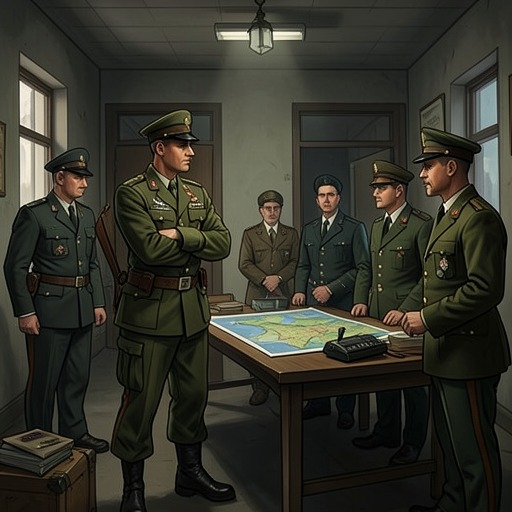
When Cantwell explains what it meant to be a general, he reduces command to its working apparatus: trailers for the general and chief of staff, a command post for staff officers, a plastic-covered map, coloured boundaries, regiments and battalions, companies, artillery, tanks, and supply parts. Units must stay within boundaries so that they do not fire on one another. The commander, he says, lives by coordinates. The orderly map is a striking counterpoint to the disorder experienced by the soldiers expected to carry out its plans.
Cantwell remembers receiving a regiment after its previous commander, a young man he had known since he was eighteen, was relieved. It was the regiment he had hoped to command until he lost it, under orders. As he recounts the loss, he describes a decision to attack toward high ground where the opposing professionals might have negotiated a surrender. Instead, an order from higher headquarters required an assault because the town’s name had appeared in a newspaper. The explanation traces how a decision could travel down through layers of command, gaining force while becoming detached from the local circumstances Cantwell believed mattered.
The division’s identity remains vivid in his memory. He recalls serving alongside the 1st Infantry Division, the 9th Division, and his own division, and says his own unit repeatedly went where it was sent. Its four-leaf clover insignia meant little outside the division but mattered deeply to those who wore it; some observers mistook it for ivy. Before a later attack, divisional patches were removed, yet one regiment was committed before the assault began, making concealment ineffective. Cantwell describes the attack as three forces in line with nothing in reserve, against conditions he already understood to be unfavorable. The regiment was destroyed. He refuses to make its commander a scapegoat, remembering him instead as a man he would willingly share hardship with again.
Two Wars in One Landscape
The Second World War recollections are framed by Cantwell’s earlier experience as a young officer on the Piave. Driving toward Venice, he sees a road that now appears ordinary but still carries the memory of old positions. During the earlier fighting, bodies had been thrown into canals to clear the riverbank and road; Austrian-held gates downstream remained closed, so the water moved too little to carry them away. Labor troops later pulled the dead out at night and buried them beside the road. In the present, ducks and geese occupy the canals and people fish there. The familiar landscape has returned to ordinary use, but its peaceful appearance does not erase what happened there.
Cantwell also remembers fighting with a sore throat, teaching his soldiers to shoot, and counting quickly after bombardments to discover how many men remained able to fire. Three wounds had seemed to him like minor reprieves from death; a later, more serious wound ended his sense of personal immortality. In this contrast, the earlier war provides a measure for the later one: experience does not make death abstract, but it can make survival feel temporarily guaranteed before that belief fails.
On the approach to Venice, the church tower of Torcello and the campanile of Burano appear beyond the marshes, with sailing barges heading toward the city. Cantwell thinks of defending Venice along the canal without being able to see it, and of seeing it later from near Noghera without reaching it. He calls it his city because he fought for it as a boy and believes the people there recognize that service. The novel places that claim beside the altered Piave, whose water has been diverted for hydroelectric projects, and the dead canal banks now used for fishing. War remains in the account not only as remembered campaigns, but as a past lodged in the routes, waterways, and loyalties through which Cantwell makes his way home.